Tuesday, July 5, 2022

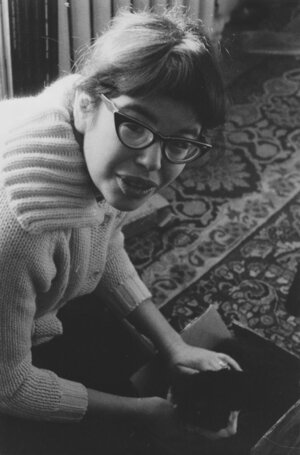
Poem for 7/5/22 - "Portrait of the poet as a young nerd" by Marge Piercy


Portrait of the poet as a young nerd

by Marge Piercy


At fourteen, at seventeen, at twenty-two

I chased myself through books.

I slipped into bodies of actresses,

mimicked their gestures, tried their smiles,

tilt of head, thrust of hip.


I could not find myself in any mirror.

I was not what I was supposed to be.

I did not look like anyone I saw.

My thoughts were weird as the monsters

superheroes killed in comic books.


As a girl I was a failure. I could

pick a lock but could not flirt.

Sports seemed pointless. Words

came easily, too easily, blabbing

me into tar pits of trouble.


I did not want to be a boy. Most

of them were imbeciles, I thought,

nor did I want to be a girl or woman.

Maybe I would grow up to be a cat.

Maybe I was an alien, a changeling.


I watched myself for extra powers

the ability to read minds, to leap

tall buildings, to look through walls

but found only a balky intelligence

and that slippery passion for words:


words talking in my head, words

building palaces along rusting

tracks of the Detroit Terminal Railroad.

Words had broader wings than pigeons,

bore the beaks and claws of eagles.


Thursday, June 30, 2022

Poem for 6/30/22 - Museum Piece by Richard Wilbur


Museum Piece

The good grey guardians of art
Patrol the halls on spongy shoes,
Impartially protective, though
Perhaps suspicious of Toulouse.

Here dozes one against the wall,
Disposed upon a funeral chair.
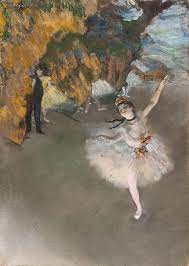
A Degas dancer pirouettes
Upon the parting of his hair.

See how she spins! The grace is there,
But strain as well is plain to see.
Degas loved the two together:
Beauty joined to energy.

Edgar Degas purchased once
A fine El Greco, which he kept
Against the wall beside his bed
To hang his pants on while he slept.

— Richard Wilbur

Wednesday, June 29, 2022

Poem for 6/29/22 - "Easters" by Donald Hall

 Easters

by Donald Hall

from The Painted Bed (2002)


  • The epigraph to this book comes from the Urdu poet, Faiz Ahmed Faiz, and reads: “The true subject of poetry / is the death of the beloved.”


  • Note that Hall is the widower of the American poet, Jane Kenyon, who died in 1995.


On the first of the four Easters

she could still swallow, and six

days before death took her last

Communion. The tall young minister

prayed as if taking dictation

from a dying bloodstream.


On the second Easter I orbited

the world in a lust of quickness

that bloodied itself into rage

imagining murder, and collapsed

to despair. Nowhere among blasted

lilies could grace find an earth.


On the third Easter I sang hymns

and remembered earlier Aprils

when we gathered cold on the hill

at sunrise by Ansel and Edna's house,

ate homemade bacon and hot cross buns.

The grave remained the grave.


On the fourth Easter the passionate

minister with the face of a boy

spoke as he blessed Communion,

and my spirit lightened for the first

time since her death at the image

of a tomb opened, a hooded figure.


Now it is May: green hay, black flies,

and the returning peonies, each

year smaller without her attentions.

Ivisit her grave walking with Gus

but without ghosts; with daffodils,

carved names, and one year blank.


Tuesday, June 28, 2022

Monday, June 27, 2022

Thursday, June 23, 2022

Poem for 6/23/22 - Monet's Waterlilies by Robert Hayden


Monet's Waterlilies

Today as the news from Selma and Saigon
poisons the air like fallout,
I come again to see
the serene, great picture that I love.

Here space and time exist in light
the eye like the eye of faith believes.
The seen, the known
dissolve in iridescence, become
illusive flesh of light
that was not, was, forever is.

O light beheld as through refracting tears.
Here is the aura of that world
each of us has lost.
Here is the shadow of its joy.


Wednesday, June 22, 2022

Poem for 6/22/22 - Genius by Billy Collins


Genius

by Billy Collins

was what they called you in high school
if you tripped on a shoelace in the hall
and all your books went flying.

Or if you walked into an open locker door,
you would be known as Einstein,
who imagined riding a streetcar into infinity.

Later, genius became someone
who could take a sliver of chalk and squire pi
a hundred places out beyond the decimal point,

or a man painting on his back on a scaffold,
or drawing a waterwheel in a margin,
or spinning out a little night music.

But earlier this week on a wooded path,
I thought the swans afloat on the reservoir
were the true geniuses,

the ones who had figured out how to fly,
how to be both beautiful and brutal,
and how to mate for life.

Twenty-four geniuses in all,
for I numbered them as Yeats had done,
deployed upon the calm, crystalline surface—

forty-eight if we count their white reflections,
or an even fifty if you want to throw in me
and the dog running up ahead,

who were at least smart enough to be out
that morning—she sniffing the ground,
me with my head up in the bright morning air.