Wednesday, October 2, 2019

How Moses Comes to Terms with Mortality

Parashat Vayelech (Deuteronomy 31:1-30)

Published on Hebrew College's "70 Faces of Torah" Blog on October 2, 2019

In my work as a geriatric chaplain in a Jewish setting, I have found that the story of Moses’s death — and God’s decision to deny him the satisfaction of entering the Promised Land — often resonates with people who are themselves struggling with the reality of their own mortality. One man in particular, a regular attendee of religious services who died recently, would begin raising questions about God’s justice whenever the topic of Moses’s death arose throughout the books of Numbers and Deuteronomy. I can only wish that I recognized at the time how clearly his complaints reflected his own fear and rage in the face of his own inescapable demise. If I had, I might have suggested that we read Parashat Vayelech, this week’s Torah portion, together, to see how Moses himself moved from the desperate pleadings of Parashat Vaethanan to the calm reassurance of a man who has come to terms with death.

The first words of the portion, Vayelech Moshe — “Moses went,” hints at this shift. Commentators debate as to where in fact Moses went, but quite possibly the movement in question is psychological rather than physical, especially since his first words to the Israelites here include an acknowledgement that he can no longer function as he once did: “And he said unto them: I am a hundred and twenty years old this day; I can no more go out and come in; and the LORD hath said unto me: Thou shalt not go over this Jordan” (Deut. 31:2)

Rashi suggests that Moses’s invocation of his birthday indicates that his days and his years have filled out — that this day, according to tradition it is 7 Adar, will also be the day of his death. He knows he has reached the end of his life and the end of his leadership (which is how Rashi understands his inability to go out and come in rather than any physical frailty), so he states without bitterness that he will not cross the Jordan. He goes on to assure the Israelites that God, along with his successor Joshua, will cross over with them. He closes his brief address with the words: “Be strong and of good courage,” assuring the Israelites that God will not forsake them.

Turning his attention to Joshua, but still speaking in front of the people, Moses repeats this imperative (now in the singular): “Be strong and of good courage,” giving Joshua his charge to lead the people and to apportion the land among them. As with the Israelites as a whole, God will be with Joshua, and will not forsake him.

In this initial section of the parasha, Moses is occupied not with his own death or his feelings of loss, but with his concern for the people, who will soon face the unknown without him. They can still recall the generation of the spies, their parents who were unable to meet God’s challenge to occupy the land God promised to them. As Moses will point out later (see Deut. 31:27), even in his presence the people struggle to resist the lure of idolatry. What will happen once he, their leader and primary bulwark against God’s towering rage, has passed from the scene? Thus he reassures and encourages his people rather than bemoaning the unfairness of his own fate.

Towards the end of the parasha, Moses, speaking privately to Joshua, again repeats what now feels like a mantra: “And he gave Joshua the son of Nun a charge, and said: ‘Be strong and of good courage; for thou shalt bring the children of Israel into the land which I swore unto them; and I will be with thee’” (Deut. 31:23)

Or is it Moses who speaks these words? Although the clear antecedent of the verb “and he gave…a charge” is Moses, Rashi and other commentators are quick to insist (as are most of my students when we study this passage) that God speaks these words, the first time God has addressed Joshua directly. If that is so, God echoes Moses’s encouragement, repeating the words “be strong and of good courage,” which God will repeat to Joshua three more times in the first chapter of the latter’s eponymous book.

In that first chapter, however, God comes to Joshua, who is described as Moses’s servant, after Moses has died, suggesting that this is the first time God speaks to Joshua directly. Read this way, the earlier statement is Moses speaking on behalf of God (which is not unusual in the Torah or the Prophets). This dual voice gives this statement an additional resonance: not only will God be with Joshua in the Promised Land, but Moses will be there as well — not in any physical way, but spiritually, as the human source of the divine teaching that will guide the Israelites’ path through the challenges that lie ahead.

Significantly, the words of Moses’s refrain, hazak v’ya-ameitz, echo the words of the final verse of Psalm 27, hazak v’ya-ameitz libeka — “be strong and let thy heart take courage”–which Jews read every day from the beginning of the month of Elul to prepare for the High Holidays. Vayelech also helps us prepare for the Yamim Nora’im, since the Torah-reading cycle places it either just before Rosh Hashanah or, as is the case this year, between Rosh Hashanah and Yom Kippur.

Every year, we, like the Israelites on the cusp of the Promised Land, like Joshua taking on the mantle of his great predecessor, like Moses himself, facing his own mortality, face the unknown, the awesome realization that we do not and cannot know the future. We know only that it will not be easy; that we, despite our best efforts, will stray from the path; and that we, even if we are healthy, never know when our lives will end. So through liturgy like Unetaneh Tokef and the symbolic death of our Yom Kippur rituals of self-denial, we stare into the abyss of our own mortality. The drama of Moses’s death provides a model for that process. We echo both God and Moses in our exhortation to ourselves and others to be strong and of good courage — that we will survive the ordeal of symbolic death on the high holidays (even as we know that our physical survival is only temporary) and that in leaving our descendants with encouragement and assurances (rather than focusing solely on our fear of own mortality), we ensure our spiritual survival.

Monday, July 15, 2019

A Blessing of the F(l)eet

This post was published in The Brookline Tab on July 15, 2019


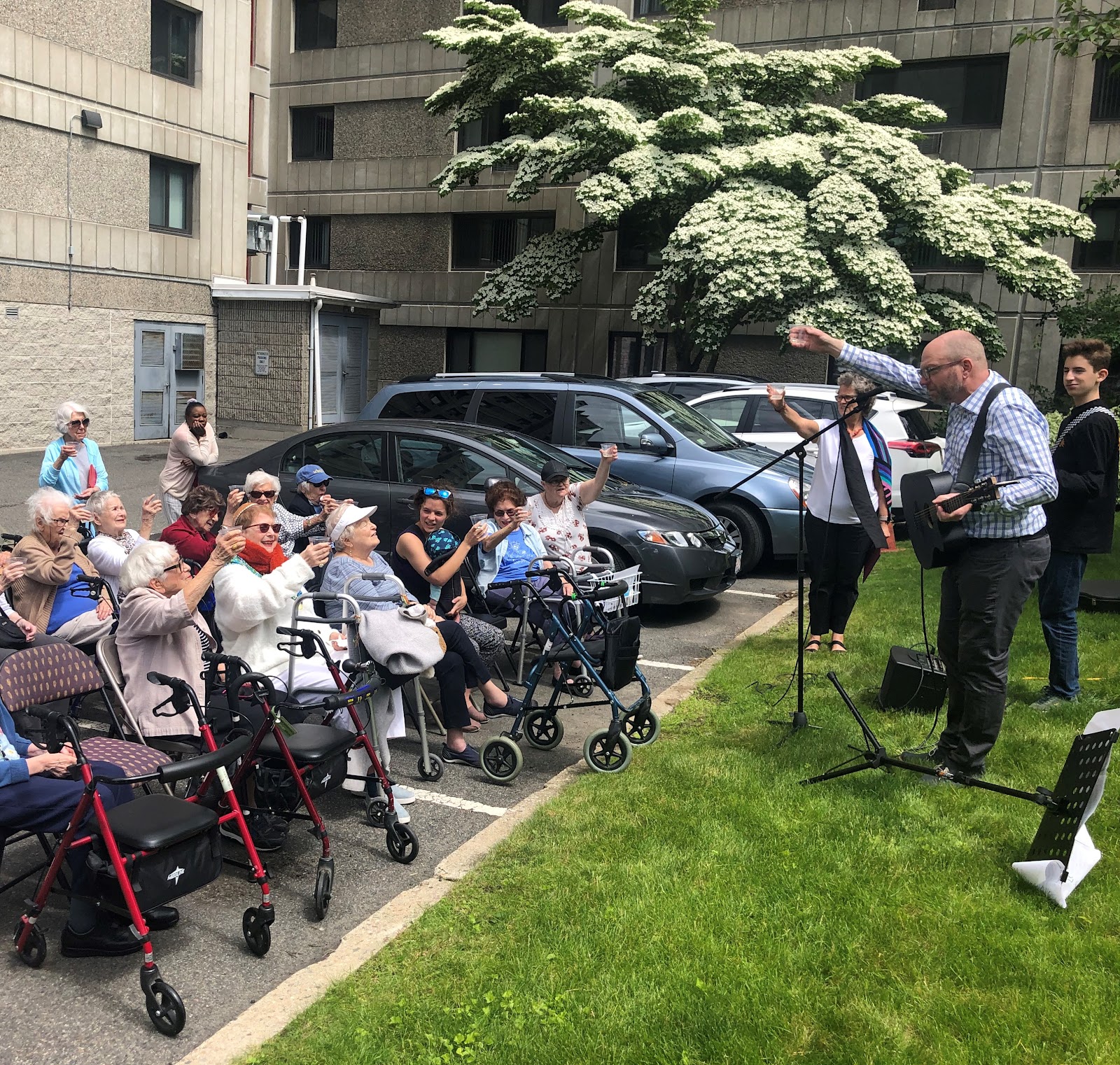
On Friday, June 14, a group of seniors who live at the Danesh Residences at 100 Centre Street came together with Rabbi Jim Morgan of Center Communities of Brookline, and Reverend Lisa Perry-Wood of the First Parish in Brookline for “A Blessing of the F(l)eet,” a celebration of mobility for people who use any kind of device to get around (including feet!).


Some months ago, in the dead of winter, Danesh resident Anne Umansky came up with a Vitalize 360 goal with her Vitalize coach, Amanda Benduzek. Her plan was to bring people together in the spring time to celebrate our continued mobility and to bless the devices that allow us to keep moving. When Anne brought the idea to Rabbi Jim, who is a member of the Vitalize 360 interdisciplinary team, he was immediately enthusiastic but knew that he would need an interfaith partner to make the idea a reality. He called on his Unitarian-Universalist colleague, Reverend Lisa, who was equally enthusiastic and set about putting together a liturgy for the event. As Anne said, “I am so happy that this head can still come up with ideas that will blossom into reality!”


The event itself was simple and full of joy--Rabbi Jim and volunteer guitarist Maximo Silverman played a rollicking Sephardic melody that got people’s feet moving as the seats filled up. Rev. Lisa introduced the event and read a variation on Psalm 23 that gave thanks for all the ways we are able to keep moving. Rabbi Jim offered a traditional Jewish blessing for the miracles of our bodies, and then Rev. Lisa blessed all of the walkers, scooters, rollators, and canes that people had brought with them. Her last blessing was for the Baby Bjorn worn by Julie Miller, a Research Associate from MIT’s AgeLab who had joined us for the afternoon with her three-month-old son, Ezra. Finally, Rabbi Jim offered a blessing that rabbinic tradition associates with feet--the most basic of all mobility devices! We then said a toast over some sparkling wine (in lieu of smashing a champagne bottle on somebody’s walker!) and everyone sang along to “These Boots Were Made for Walking.”


Anne was thrilled with the event, especially the way it brought everyone together in the beautiful sunshine. She continued: “My motto these days is from E.M. Forster: Only Connect, and today we’re connecting because we’ve all faced the same challenges and are still able to celebrate that we’re still alive.”  Julie Miller, who was at the event representing MIT’s AgeLab, pointed out how important it is for people to continue to make meaning out of the challenges that face them as they get older. For Rabbi Jim of HSL, it was a reminder of the power of reframing: “What if we can see a walker as a blessing rather than--or perhaps as well as--a burden?”


The answer to that question was evident in the way every participant’s face lit up as they received their individual blessing, a moment of affirmation and connection amid all the challenges in their lives.


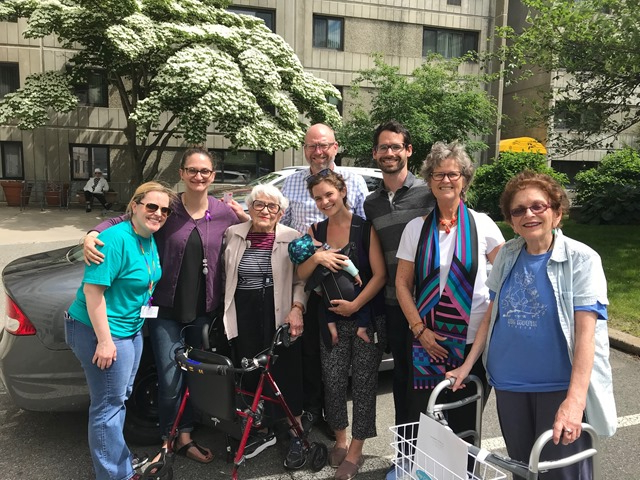
CCB staffers Amanda Benduzek, Becca Mayfield, and Rabbi Jim Morgan celebrate mobility with CCB residents Anne Umansky and Gail Flackett, Reverend Lisa Perry-Wood of First Parish in Brookline, and Julie Miller (with Ezra) and Adam Felts of MIT’s AgeLab. Anne, who participates in Vitalize 360 with Amanda, created the event, called “A Blessing of the F(l)eet: An Interfaith Celebration of Mobility,” in cooperation with Rabbi Jim and Reverend Lisa.

Tuesday, July 24, 2018

Shabbat and the Persistence of Slavery

Parashat Va’etchanan (Deuteronomy 3:27-7:11)

This post was published on Hebrew College's blog "70 Faces of Torah" on July 24, 2018.


Not everything that is faced can be changed, but nothing can be changed until it is faced.

- James Baldwin


Nearly seventy years after its publication, Ralph Ellison’s masterpiece, The Invisible Man, continues to resonate with our nation’s continued experience of race, violence, and blindness. The horrifying scene of white cop murdering an unarmed black man, Brother Tod Clifton, finds echoes in too many American places, as does the almost perverse refusal to see the ongoing effects of slavery and oppression, including the benefits that continue to accrue to the descendents--in the broadest sense of the term--of the oppressors.


In Ellison’s account, this blindness has two aspects, the moral and the historical. Paraphrasing William Faulkner, he writes that “what is commonly assumed to be past history is actually...part of the living present. Furtive, implacable and tricky, it inspirits both the observer and the scene observed...and it speaks even when no one wills to listen.” This willful historical blindness enables what he calls the “feigned moral blindness” of most American whites, allowing them to ignore ongoing discrimination and violence by assigning slavery and its effects to “past history.”


This tendency towards moral and historical blindness that Ellison identifies in The Invisible Man is certainly not limited to his era. Indeed, we witness a numbing profusion of contemporary examples in our newspapers and on social media, with the effect that we can become exhausted and even begin to welcome the false comfort of historical and moral blindness. The Torah is also aware of this danger, most notably in the repeated injunction not to forget that we were slaves to Pharaoh in Egypt as a basis for pursuing justice for the stranger, the widow, and the orphan.


One such injunction occurs in Parashat Va’etchanan, in the repetition of the 10 Commandments, which occurs at a moment when the Israelites are poised to enter the promised land, when the Exodus will soon enter into history as the legacy of a generation that has passed away. There is a danger, the Torah seems to understand, that the past will die and that history will be forgotten.


As Moses gathers the new generation of Israelites to review the revelation at Sinai, he admonishes them:


The Eternal our God made a covenant with us at Horeb. It was not with our ancestors that the Eternal made this covenant, but with us, the living, every one of us who is here today. (Deut. 5:2-3)


Commentators, both traditional and modern, hasten to assure us that Moses’ exclusion of ancestors is not literal, but elliptical. The medieval commentator Rashi, for instance, reads the phrase “not with our ancestors” as “not with them alone.” His reading renders this passage consistent with the one later in the book that states: 


I make this covenant...not with you alone, but both with those who are standing here with us this day...and with those who are not with us here this day (Deut. 29:13-14)


Moses’ insistence that God made the covenant with the current generation points to the radical implications of these passages: revelation is a transhistorical reality and the covenant is renewed in every generation, indeed every time we strive as Jews to follow God’s commandments and thus to encounter God’s presence. This capacity for renewal leads to the rabbinic understanding that the soul of every Jew was present at Sinai.


Yet Rashi’s gloss on Deut 3:2-3 reminds us that revelation--and the covenant it engenders--was also a historical event: it happened at a particular moment and thus we are enjoined throughout the Torah to remember it. As both transhistorical reality and historical event, it becomes like Faulkner’s idea of history: in the past but never past, forever popping up, often at times when it might feel more convenient to forget it.


One of those times, perhaps, would be the fourth commandment, which is the only one of the ten to undergo substantial revision in Deuteronomy:


Observe the sabbath day and keep it holy, as the Eternal your God has commanded you. Six days you shall labor and do all your work, but the seventh day is a sabbath of the Eternal your God; you shall not do any work—you, your son or your daughter, your male or female slave, your ox or your ass, or any of your cattle, or the stranger in your settlements, so that your male and female slave may rest as you do. Remember that you were a slave in the land of Egypt and the Eternal your God freed you from there with a mighty hand and an outstretched arm; therefore the Eternal your God has commanded you to observe the sabbath day. (Deut. 5:12-15)


In the book of Exodus, the first word of this commandment is “remember” (zakhor), and Moses couches observance of the Sabbath as an imitation of God, who rested on the seventh day after the six days of creation. In Deuteronomy, the command is to “observe” (or to “guard”--shamor), and the focus shifts from creation to redemption. Rashi, following rabbinic legend, suggests that God actually spoke the two words simultaneously, as part of a single utterance. Be that as it may, the fact is that both words appear in Deuteronomy: we must observe the Sabbath but also remember that each one of us (the verb here is in the singular) was a slave in Egypt and that God redeemed us from there. The injunction to observe does not replace so much as augment the injunction to remember.


Furthermore, the phrase “so that your male and female slave may rest as you do” does not appear in Exodus, the jarring implication here being that we, those who are commanded to observe the Sabbath, will likely own slaves. And as the experience of our own experience of slavery and subsequent liberation fades into “past history,” we will tend to forget it, which may tempt us to turn a blind eye to the oppression--especially our oppression--of others. We must, unlike Pharaoh, know that those who serve us are humans and treat them the way we treat the rest of our household: as entitled to rest on Shabbat as the rest of us. 


Of course the vast majority of us, Jews and non-Jews alike, abhor the idea of slavery and strive to treat all people with the highest ethical standards; despite the reality that slavery in many forms still exists in our world, most of us do not participate directly in the oppression of others. For that reason, we must not take the notion of “owning slaves” literally, lest we dismiss it as yet another biblical idea that belongs safely in the past and thus has no relevance to our lives. Just as many Jews have internalized the admonition not to forget that we were once slaves in the land of Egypt, we should also not forget that we, as it were, “had slaves,” which is to say that we have likely benefited from the oppression of others, even if we did not participate in that oppression and even if we might prefer to turn a blind eye to that inconvenient truth. As Ellison and countless others before and after him have affirmed, the legacy of slavery and Jim Crow still loom over our national life in ways that too many of us wish to ignore. We must acknowledge and struggle with that reality and do all that we can to end that oppression.


Wednesday, December 27, 2017

Responsum on Latkes

This post first appeared in the 100 Centre Street Journal in December, 2017


Q: I know that Hanukkah is already over, but I’ve been wondering why Jews eat latkes on Hanukkah? How long has that been the tradition and how widespread is it? And what about those jelly donuts?


A: As with many cultural practices, we often assume that since we (or perhaps our parents, or perhaps our friends’ parents) grew up with a particular custom (such as latkes on Hanukkah), that custom must date from time immemorial. In Judaism, we have a term for such a thing: mi-sinai (pronounced mee-see-nigh), which means “from Sinai,” which is to say that Moses received it from God along with the 10 Commandments, so who so we we think we are to suggest that we do something different!?


There are significant problems with declaring latke-eating a “mi-sinai” tradition, however, not least of all the fact that Hanukkah was not declared an official Jewish holiday until very late in Jewish history, so it’s not mentioned at all in the Torah (or anywhere else in the Bible). Perhaps an even bigger problem, however, is that even if we wanted to claim that Judah Maccabee fried the first latke, we would have to figure out where he came up with potatoes during the second century BCE (before the common era): potatoes are a New World crop, and did not arrive in Europe until the 16th century, when Basque sailors brought them from Peru to Northern Spain. Presumably, they arrived in the land of Israel even later than that.


To get to the story of latkes, however, we need to address another mi-sinai tradition in Judaism, namely the practice of eating special foods on Shabbat and Holidays, most universally matzo for Passover. The vast majority of other holiday culinary traditions, however, are specific to particular groups of Jews and are usually based on the local and seasonal foods available where they lived. So, when Hanukkah began to develop as a holiday, there were all kinds of questions about what it meant and how one should light the candles; the famous question in the Talmud is “Mai Hanukkah?”: what is this Hanukkah business? Among the questions (although I’m not sure it’s in the text of the Talmud itself) was: well, what are we going to eat?!


According to scholars, among the first answers to that particular (and crucial!) question was list that appeared in a14th century liturgical poem by Rabbi Kalonymus ben Kalonymus ben Meir (b.1286 – died after 1328), which, among other foods, talks about levivot, pancakes fried in a pan, presumably in olive oil. These pancakes tended to be made of cheese and/or flour, and indeed, throughout the Jewish world, people tended to eat sweet cheese treats at Hanukkah time, including cheese blintzes in Ashkenazi traditions and cassola (ricotta pancakes) in Italy.


The olive oil makes sense, given that the Talmud’s Hanukkah story emphasizes the miracle of the oil. But cheese? A bit later in the 14th century, in a gloss to the Talmudic discussion of Hanukkah in Tractate Shabbat, a Spanish authority, Rabbi Nissim of Gerona (ca. 1310-1375), writes: “it says in a midrash that the daughter of Yohanan [the High Priest] fed the enemy leader cheese to get him drunk and cut off his head and they all fled, and therefore it is customary to eat cheese on Hanukkah.” 


Here Nissim is conflating two traditions: the Maccabean revolt (thus Yochanan) in 165 BCE and the legend of Judith, whose story was first written down some sixty years earlier (115 BCE). Judith was the heroic widow who lured Holofernes, the Assyrian general whose forces were besieging her town, into her tent with the promise of food and drink. In medieval versions of the story, Judith gave the general levivot, pancakes, studded with salty cheese and plied him with wine (the more cheese, the more wine). When he was completely drunk, she cut off his head with his own sword, which so frightened his troops that they all ran away. A miracle indeed!


In the European context, however, where olive oil was scarce outside of Spain and Italy, fried cheese presented a challenge, however, since the primary cooking oil came from animals. Non-Jews used lard, of course, derived from pigs, but Jews tended to use chicken and especially goose fat for cooking. Therefore, dairy foods gave way first to buckwheat and grains. The final step was the shift from grain to potatoes as the primary food crop in Eastern Europe during the in 17th  and 18th centuries. So the Ashkenazi ancestors of the majority of American Jews would have had access to potatoes (and a few onions and maybe a little flour or matzo meal for binding) to make latkes. Given that they were fried in schmaltz, however, I doubt that sour cream was a common condiment--I assume that was a non-Jewish custom that caught on among Jews when vegetable oil took pride of place from animal fats.


As a final note, you may be wondering about sufganiyot, the ubiquitous (in Israel) Hanukkah jelly donut that is seen as the usual alternative to latkes. Although fritters of various descriptions populate the Hanukkah table in many traditions, the specific forbearer of sufganiyot hails from much the same place as the latke: the Polish ponchik, which travelled to Palestine in the early 20th century with Eastern European Zionists and quickly monopolized the Hanukkah season.


So indeed, the tradition of eating latkes (or sufganiyot) for Hanukkah is both temporally and culturally specific, which is wonderfully liberating, since we can feel free to enjoy them (or not!) as well as to experiment with other traditional Hanukkah foods, such as cassola and blintzes. Happy New Year!!


Tuesday, December 12, 2017

Joseph, Pharaoh, and the Perpetual Stranger

Published on Hebrew College's Blog "70 Faces of Torah" on December 12, 2017.

This year, as is often the case, we read Parashat Mikeitz on Shabbat Hanukkah, a celebration of light that affirms the durability of our Jewish identity even in periods of assimilation and even oppression. During one such period--of assimilation in the United States and of genocide in Europe--Muriel Rukeyser spoke about the gift of being a Jew:

To be a Jew in the twentieth century
Is to be offered a gift. If you refuse, 
Wishing to be invisible, you choose
Death of the spirit, the stone insanity.
Accepting, take full life. Full agonies: 
Your evening deep in labyrinthine blood
Of those who resist, fail, and resist: and God
Reduced to a hostage among hostages.

The gift is torment. Not alone the still
Torture, isolation; or torture of the flesh.
That may come also. But the accepting wish,
The whole and fertile spirit as guarantee
For every human freedom, suffering to be free,
Daring to live for the impossible. (1944)

This poem, which later entered Reconstructionist and Reform prayer books, reads as a gloss, not only on the ambiguities of Hanukkah, but also on Joseph’s story in Mikeitz, where he faces the choice of embracing the gift of “torment” and “human freedom” or remaining “invisible.”

At the outset, Joseph is a Hebrew--an ivri. As scholars point out, this unstable word toggles between a geographical (“the one from beyond,” or “the migrant”) and an ethnic designation (derived, perhaps, from the sons of Eber in Genesis 10:21, although it refers only to the descendants of Abraham, Isaac, and Jacob). In the context of Joseph’s (and later Israel’s) sojourn in Egypt, however, it distinguishes a Hebrew from an Egyptian as a marker of foreignness, itself an ambiguous concept. Joseph proudly declares himself a Hebrew in Genesis 40 even though a chapter earlier, Potiphar’s wife upbraids her husband for bringing a Hebrew into their house for sexual dalliance.

After Pharaoh reports his impenetrable dreams about cows and corn, his royal cupbearer recalls a person who might interpret them: “a young man, a Hebrew, servant to the captain of the guard” (Genesis 41:12). Rabbinic tradition understood his words differently than this modern translation, casting aspersions on the cupbearer for describing Joseph as a lad--na’ar, a foreigner/Hebrew--ivri, and a slave--eved, all assertions of his inferiority. More troubling, to my mind, is that he stops short of calling Joseph by name, as though his status as a Hebrew and a slave relegate him to namelessness.

Joseph’s transformation from a Hebrew slave to an Egyptian vizier begins immediately upon his release from prison, as he shaves and receives new clothes in preparation for his audience with Pharaoh. When he offers both an interpretation of Pharaoh’s dreams and a plan for addressing the impending seven years of famine, Joseph accepts Pharaoh’s signet ring, another set of even finer clothes, and a gold chain, raiment that conveys his newly elevated status among the Egyptians. Finally, Pharaoh gives Joseph an Egyptian name and an Egyptian wife (although Rabbinic tradition insists that his wife, Asenath, was actually the daughter of Dinah and Shechem). For all intents and purposes, Joseph’s transformation from ivri to Egyptian is complete. He has become invisible. But has he accepted the “Death of the spirit?”

Intimations that he has not include the narrator’s continuing references to Joseph by his Hebrew name. And when Joseph becomes a father, he chooses for his sons not Egyptian names but Hebrew ones, connecting them to God’s grace in helping him overcome the suffering of both his early upbringing (Menashe) and of his affliction in Egypt (Ephraim). Beyond this ongoing connection to Hebrew, we find that after the birth of Joseph’s sons, Pharaoh himself seems to refer to Joseph by his Hebrew name. That name, however, could not have been the one that gained worldwide fame, since if it were, the sons of Jacob would have known that this Egyptian vizier was named Joseph and might have reasonably recognized him as their brother.

Despite these hints at an ongoing Hebrew identity, however, the word ivri itself remains submerged until the fateful scene of Joseph’s banquet with his brothers. As many commentators point out, both the brothers and the Egyptians find it astonishing that Joseph invites these Hebrew sheep herders for a meal, because both Hebrews, at least during meals, and shepherds (in Gen. 47) represent for Egyptians a toevah, a contested term which has traditionally been translated as an “abomination” (and as such stands at the center of the contemporary debate about the bible’s attitude towards same-sex intercourse in the book of Leviticus), but which, as Jay Michaelson and other scholars have argued recently, is in many contexts more likely to mean “foreign cultic practice.”

The verse reads: “[The servants] served [Joseph] by himself, and [the Hebrew brothers] by themselves, and the Egyptians who ate with him by themselves; for the Egyptians could not dine with the Hebrews, since that would be abhorrent to the Egyptians” (Gen. 43:32). Modern commentators tend to see this verse as evidence of the Egyptians’ xenophobic feelings of religious and cultural superiority. Targum Onkelos, however, suggests that the source of the toevah was the fact that the Hebrews were eating lamb, an animal that Egyptians worshiped, which would make it impossible for them to eat at the same table as the Hebrews (Onkelos likely bases his reading on Exodus 8, where Moses doesn’t want to make an animal sacrifice among the Egyptian population for fear that they would take it as a toevah and stone the Hebrews to death). Onkelos’s suggestion, however, seems off as well, since no one among Joseph’s Egyptian staff appears to find it off-putting that he calls for an animal to be slaughtered for the banquet. Most likely, the prohibition, much like Kashrut in many traditional Jewish communities, served to maintain the boundary between Egyptian and foreigner--to prevent an expansion of the kind of cultural blending that Joseph and his family seem to represent.

If that is the case, however, why does Joseph also sit alone--neither with the Hebrews nor with the Egyptians. Is his isolation a result, as again many commentators suggest, of his own superior position over his Egyptian advisors and retainers? Indeed we have no evidence from the text that Joseph ever sat together with his staff--or that he didn’t. However, I want to speculate in the context of cultural boundaries that Joseph here is following the narrow path of the ivri with an Egyptian name: the one who crosses cultural boundaries must maintain these cultural distinctions internally, struggling to maintain their own identity while also remaining safe and alive. It also represents his place “in between,” in the liminal space between cultures that brings him such danger and such power.

Ultimately, like Moses after him, Joseph will reveal his full, composite identity in order to deliver his family and his people from affliction to freedom. That liminal status, however, will never leave him. And here perhaps we begin to understand that the fullest embrace of the identity of an ivri is not solely ethnic but also geographical and cultural: one who crosses over, stands forever in between, a perpetual stranger.

At Hanukkah, we celebrate his composite Jewish identity--Hebrews thoroughly mixed not only with Hellenists but also with all the cultures that we’ve assimilated and influenced over the centuries. And as Rukeyser’s poem reminds us, the choice to be a Jew is no simple gift, no stable identity; indeed it often feels easier to remain invisible, both personally and communally. Joseph’s full embrace of his liminal identity will deliver his family from affliction but eventually lead the Israelites into slavery and near genocide in Egypt. So too Moses, who in recognizing his status as both Hebrew and Egyptian, will face much “torment” and “labyrinthine blood” in “daring to live for the impossible” and “suffering to be free.”

Thursday, July 20, 2017

Responsum on Jewish Denominations - July 20, 2017

Q: What are the major denominations in Judaism--and how can I keep them straight?


A: I can think of many ways to respond to this question, but I think it would be most helpful to offer two answers, one pertaining to the world as a whole; the other pertaining to North America and, to a lesser extent, Israel, where what Jews tend to call movements or streams have proliferated. (“Denominations” tends to sound rather Christian to many Jewish ears.)


Regarding world Jewry, it’s important to recognize that before the 18th century in Europe--and until today in many places--there was really no denominationalism in Judaism, at least as we understand it today. There were certainly sects and schisms and arguments, but there was no Orthodox or Reform, and certainly no Conservative, Reconstructionist, or Renewal Jews. Rather, there was a wide variety of Jewish practice based on geography, broadly divided into Ashkenazic (European) and Sephardic (literally Spanish, but spread across North Africa and Arab lands, including the Land of Israel). It’s important to note that these two broad regions experienced modernity very differently, which is why Reform Judaism, and after it Orthodox Judaism, are primarily European phenomena. It was there, in Central Europe, in the 18th century that a smallish group of Central European Jews decided that Jewish practice required reformation.


The European reformers modeled themselves after the Protestant Reformation, and emphasized decorum in religious services, prayers and sermons in the vernacular language, a streamlined liturgy that emphasized the ethical and rational aspects of the tradition, all with the idea that Judaism should take its place alongside the church as a dignified and respectable religion.


Like the reaction against the Reformation in a Christian context, traditionalists within Judaism pushed back hard against the reformers, even to the point of outlawing practices, like the use of organs in synagogues, that had begun to spread slowly across Europe. The founders of this anti-reform movement called themselves, somewhat misleadingly, Orthodox (correct belief), perhaps in conscious or unconscious imitation of Orthodox Christians who objected to the theological innovations of the Reformation. In a Jewish context, however, theology is much less determinative than practice and communal belonging in a person’s choice of congregation. Orthodoxy, as many scholars have pointed out, might be better called Orthoprax (correct practice).


Today, this basic division between Reform (or Progressive, as it is known outside North America) and Orthodoxy persists, although Progressive Judaism, alongside other liberal movements, is much smaller in Israel and the rest of the world than Orthodoxy, which in many countries is simply the default.


When Jews came to this country, they imbibed the particular religious spirit of the United States, which I would describe as congregational. In this country, without an established religion, everyone who didn’t like the church they grew up in could join another one or, as happened with remarkable frequency, simply start a new one. In this way, local custom, which had always been important in Judaism, became paramount, and so although there are certainly points of contact among synagogues that belong to a particular movement (prayer books, for instance, or a general attitude towards Jewish law), each synagogue developed its own culture and style of worship.


It’s also important to know that for the great waves of Jewish migration to this country came first from Central and then from Eastern Europe, thus bringing the general European division between Reform and Orthodox to these shores. This is not to say that Sephardic Jews did not arrive in America--indeed the first synagogues in this country were founded by Spanish and Portuguese Jews--but the vast majority of American Jews descended from European ancestors. 


Many of those Jews found that they felt at home neither in the traditionalist Orthodox synagogues that tried to recreate the religious life of the old country nor in the Reform synagogues that felt too alien. Thus arose what became known as Conservative Judaism, an attempt to adapt traditional practice to modern realities. During the second third of the twentieth century, Conservative Judaism was the dominant address for American Jews, but affiliation has dropped off precipitously as the movement responded slowly to the challenges of postmodernity: intermarriage,, feminism, gay rights, etc. Now many Jews, even observant Jews, do not affiliate with any movement, which has created many challenges for movement institutions.


So here is a short review of some of the major streams of American Judaism:


Reform Jews trace their roots back to the European reformers of the 18th Century. So-called “Classical Reform” emphasized prayer in the vernacular, decorum at services (rabbis would wear academic gowns at services), and engagement with social justice. More contemporary Reform maintains the emphasis on social justice, but has engaged with a more Hebrew-oriented liturgy and less formal worship. It also has spearheaded outreach to intermarried couples and encourages conversion. The Reform movement was the first North American movement to ordain female clergy.


Orthodox Judaism developed in response to European Reform, and neither was a major component of Judaism in the rest of the world until both arrived in North America in the 19th century. Although there are many branches of Orthodoxy, with degrees of observance and levels of engagement with non-Jews (and non-Orthodox Jews), all affirm the primacy of Torah and Jewish law and many reject any innovations in practice. Recently, feminism has made inroads in modern Orthodoxy, and we are beginning to see the ordination of female clergy, even if most do not go by the title of rabbi.


Conservative Judaism arose in the late 19th century as an attempt to find a traditional form of practice that would be open to historical change. Conservative synagogues offered traditional worship services with limited changes, including nods to feminism and the reality of suburban life: in a major break with tradition, Conservative Jews were permitted to drive to synagogue (but only to synagogue!) on Shabbat. In recent decades, many Conservative congregations have declined as their more traditional members migrate out to independent congregations and Orthodoxy, while their more liberal members join Reform synagogues (especially if they or their children marry non-Jews) or opt out of religious Jewish life entirely.


Reconstructionist Judaism is a truly American movement, founded in the forties and based on the ideas of Mordechai Kaplan, who emphasized Jewish civilization and a rationalist belief system. A product of an Orthodox upbringing and a professor at the Conservative Jewish Theological Seminary, his ideas have had an outsized influence on American Judaism, even if only a small percentage of Jews identify as Reconstructionist. Today, Reconstructionism is the most liberal of the movements, and is particularly welcoming to gays, lesbians, and trans people.


Independent minyanim (congregations) are now a fixture in most Jewish population centers and consist of traditional Jews, many brought up in Conservative and Orthodox households. Many are egalitarian, but others retain the Orthodox practice of separating men and women during prayer. The worship experience tends to be very traditional, and most such congregations do not have a rabbi (although many rabbis may be members) and do not offer a school, life-cycle events, or other services of a synagogue.


Finally, Jewish Renewal (or Neo-Hasidic Judaism) is an attempt to merge the revivalist, mystical, and pietistic aspects of Hasidism with modern sensibilities, especially feminism and environmental activism. Neo-Hasidic Jews identify Rabbi Zalman Schacter-Shalomi as their founder. A former Lubavitch Hasid, Reb Zalman (as he was popularly known), moved away from traditionalist circles and engaged with the wider world of spirituality (especially Buddhism). In this way, he was able to “renew” many Jewish practices, making them palatable and meaningful to contemporary Jews while unapologetically borrowing practices from other traditions (especially meditation and mindfulness). Like Kaplan, Reb Zalman had an influence that goes far beyond Jewish Renewal congregations.


I should also mention that there is a proud traditional a Jewish secularism (an outgrowth, by and large, of European secularism) that split into two main streams: Zionists, with an emphasis on the Hebrew language; and Bundists, who focused on Yiddish language and culture (a good example is the Workmen’s Circle, of which there is a branch in Brookline). Both streams were highly attuned to progressive politics, a rationalist worldview, and a serious mistrust of rabbis and religion. To this day, a majority of Israelis dentify as secular, even though Orthodox religious parties control a growing percentage of seats in the Knesset.


So where do we at Danesh-100 Centre St. fit into this picture? I should say that I myself do not fit comfortably into any of these categories, but I’m closest--by both temperament and education--to Neo-Hasidism. As the rabbi and chaplain of a pluralistic community, I do my very best to meet the needs of the broadest range of residents, so our services contain elements from all of these traditions. Furthermore, I am open to all feedback, so if there is something you would like to see me add or subtract from our services, please come by and have a conversation with me!


Wednesday, July 12, 2017

Wonder Woman and Zealotry: The Persistent Appeal of Zealotry

Parashat Pinchas (Numbers 25:10 - 30:1)

This post was published on the Hebrew College Blog "70 Faces of Torah" on July 12, 2017


In the film Wonder Woman (2017), the heroine, played by Israeli actress Gal Gadot, intervenes in World War I on the side of the Allies. She zealously seeks the destruction of Ares, the god of war (the gods are almost Greek, but seem not to be immortal). Along with her multicultural group of allies, she determines that Ares has incarnated himself as the supreme German commander, General Erich Ludendorff. She expects that once she has killed him--he is, after all, the source of conflict in the world--the war will end and peace will break out. Pursuing Ludendorff relentlessly, she finally defeats him by stabbing him through the heart with her sword. Sadly, the war continues apace: the general is not Ares after all. However, when Ares himself conveniently appears for a final showdown, there is another violent battle. Again, Wonder Woman prevails and the closing scenes show German and British soldiers hugging like the brothers they had forgotten they were.


This comic book fantasy of horrific violence to purge the world of horrific violence is reasonably standard issue, even if real life (as well as the need for sequels) reminds us that evil is never completely vanquished. It is also nothing new. Indeed we see something similar in the run up Parashat Pinchas, where the title character, the son of Elazar and grandson of Aaron the priest,  stabs an Israelite chieftain and a Midianite princess in flagrante delicto, thus halting the plague of God’s wrath that had already killed 24,000 Israelites in the wake of their apostasy with the Moabite god Baal-Peor. In case you’re counting, that is eight times more dead than in the wake of the incident of the Golden Calf.


For this horrific killing, Pinchas receives God’s covenant of peace and eternal priesthood. Because Pinchas is a biblical figure and not a superhero, this reward has bothered readers throughout history.  Concerned that we understand both that his act was legitimate and that it is nothing that we should try ourselves, the rabbis insisted that God performed several miracles in its wake (six or twelve, depending on the tradition), including that Pinchas’s spear pierced the genitals of both partners, skewering them together and thus providing proof that they were engaged in an idolatrous act of ritual intercourse. Had he killed them separately, says the Talmud, he would have been guilty of murder.


Like the rabbis, I don’t want to pretend that Pinchas is someone we should emulate, but I also don’t want to dismiss him as a progenitor of comic book heroes, whether in their current cinematic form or in earlier incarnations as, in many cases at least, mid-twentieth-century Golems of masculine Jewish wish fulfillment. What can we take from Pinchas, preferably without the violence and mass slaughter?


The first lines of Parashat Pinchas offer us a clue in the four repetitions of the Hebrew root kuf-nun-aleph: kina, translated variously as passion, jealousy, vengeance, or zeal:


And the Eternal spake unto Moses saying, Phinehas the son of Elazar, the son of Aaron the priest, hath turned my wrath away from the children of Israel, while he was zealous with my jealousy in the midst of them, that I consumed not the children of Israel in my jealousy. Wherefore, say, Behold, I give unto him my covenant of peace: And he shall have it, and his seed after him, the covenant of a priesthood for ever: because he was zealous for his God and made an expiation for the children of Israel. (Numbers 25: 10-13)


Pinchas deserves God’s covenant of peace not for the killing of Zimri and Cozbi (the names of his two victims), but for the result of his zealotry: the reversal of God’s indiscriminate violence against the Israelites. 


Rashi’s comment on verse 11 tries to make sense of the odd construction “he was zealous with my jealousy”:


 בקנאו את קנאתי - “He was zealous with my jealousy” means “when he executed my vengeance” (more lit., when he avenged my avenging) — when he displayed the anger that I should have displayed. The expression קנאה (zeal) always denotes glowing with anger to execute vengeance for a thing; in Old French emportment.


Rashi suggests that Pinchas somehow took the place of God in executing judgement, that God “should have displayed” a deadly anger against the couple, but instead lashed out at the Israelites in general who, God implies, would have not survived had Pinchas not intervened with a kina that somehow overcame God’s own kina.


The emphasis on the Old French word emportment comes up again in Rashi’s discussion of Numbers 11, where Joshua, Moses’s attendant and successor, learns that two Israelite leaders, Eldad and Medad, were speaking prophetically in the camp:


And Joshua the son of Nun, the attendant of Moses from his youth, answered and said: My lord Moses, forbid them! And Moses said unto him, Enviest thou for my sake? Would God that all the people of the Eternal were prophets and that the Eternal would give spirit unto them! (Numbers 11:28-29)


In this obviously lighter context, where Moses seems to disavow Joshua’s zeal, Rashi treats kina slightly differently:


המקנא אתה לי - “Enviest thou for my sake?” means, “art thou envying where I should envy”

לי - “For my sake”: the word לי, “for me,” meaning the same as בשבילי, “for my sake”. Wherever an expression of the root קנא (kina) is used it implies that a person sets his heart on the matter, whether it be to take vengeance or to help; — emportement in O. F. (English = zeal) — he holds the thickest (heaviest) part of the load (i.e. he takes the responsibility for carrying out a matter).


Again, we find the notion that an attendant, an agent, an ally, has taken on the task of envy or zealotry or passion in place of the being who should by rights feel it. Yet here, Rashi widens his understanding of kina to include not only envy or vengeance but also help, a concept that doesn’t necessarily involve violence. He also defines emportment as, to adopt a current idiom, doing the heaving lifting. It is almost as though Joshua, by acting indignant on Moses’s behalf, allows Moses to have a more indulgent response to the two men who might be accused of trying to usurp Moses’s status as prophet: Joshua has taken on the jealousy, thereby bringing peace to Moses.


We can apply a similar reading to Pinchas’s zealotry: by fully inhabiting the outrage and passion that God should have (and might have) felt towards Zimri and Cozbi, he relieves God of the need for continuing God’s indiscriminately violent response, thereby bringing about the end of the plague. 


Joshua’s example, however, suggests that violence is not a necessary component of kina--indeed the core of it is the lifting of a burden off the person or people to whom you are allied. Such non-violent emportment may or may not avert God’s wrath or bring an end to war (as it does in Parashat Pinchas and in Wonder Woman), but it certainly will increase peace.